
Why this topic confuses so many students
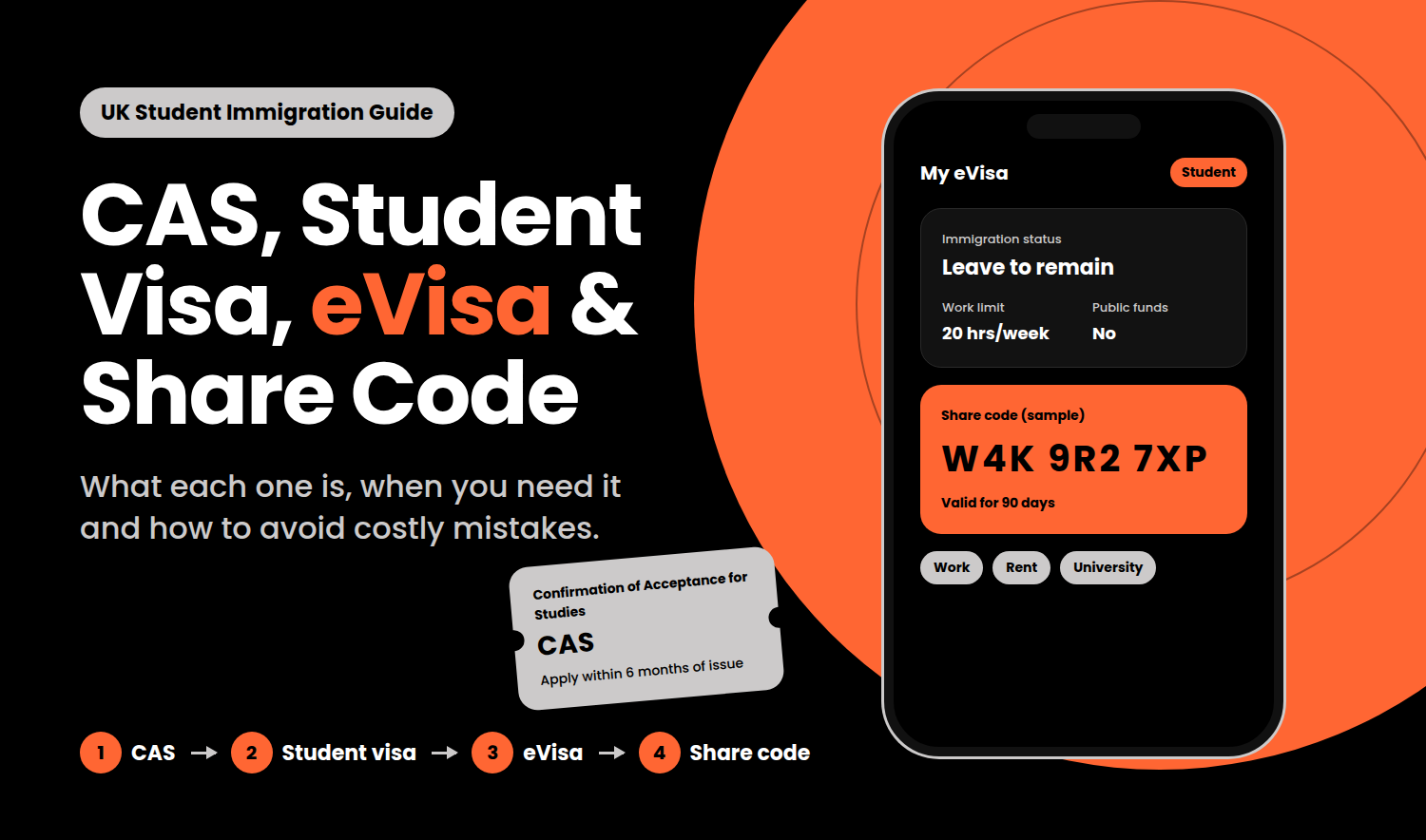
Four terms get used almost interchangeably in WhatsApp groups and Reddit threads: CAS, Student visa, eVisa and share code. They are four different things that appear at four different moments of your journey.
The confusion has a reason. The UK has moved from plastic Biometric Residence Permits (BRPs) to a fully online status, and many older blog posts and agent videos still describe the old system. Some sites even disagree on basic facts, such as how long a share code lasts or how long you need to hold your funds.
How the four pieces fit together
| Step | What it is | Who gives it to you | When you need it | What it is used for |
|---|---|---|---|---|
| 1. CAS | A unique reference number confirming your course place | Your university or college (a licensed student sponsor) | Before you apply for the visa | Entered on your visa application |
| 2. Student visa | Your permission to study in the UK | UK Visas and Immigration (UKVI) | After you have a CAS and your evidence ready | Lets you enter and stay for your course |
| 3. eVisa | Your online record of that permission | UKVI, through your UKVI account | After a successful decision | Shows your status, expiry date and conditions |
| 4. Share code | A temporary code generated from your eVisa | You, from your UKVI account | Whenever someone needs to check your status | Right to work, right to rent, university checks, travel |
Think of it as a chain: no CAS, no visa. No visa, no eVisa. No eVisa access, no share code.
What changed recently
| Update | What it means for you |
|---|---|
| Student visa fee is £558 | Same fee from outside the UK and when extending or switching inside the UK |
| Living-cost requirement: £1,171 (outside London) or £1,529 (London) per month | Set by the Home Office, not by your university |
| Graduate visa shortens to 18 months for applications from 1 January 2027 | The date of your visa application matters, not your course start date |
| Expired BRP sign-in window ends by 31 December 2026 | Move your UKVI sign-in to your passport now |
| Expanded right-to-work checks from 1 October 2026 | Employers must check a wider range of workers, which can include some casual, agency and platform work |
| Visa brake on study visas for nationals of Afghanistan, Cameroon, Myanmar and Sudan (announced March 2026) | Affects those nationalities only, with a review planned after 18 months |
| International student levy of £925 per student on English universities from 2028/29 | Not paid by students directly, but may influence future tuition pricing |
Part 1: CAS (Confirmation of Acceptance for Studies)
A CAS is a reference number. Once your education provider offers you an unconditional place, they send you this number and you must enter it on your visa application. The provider must be on the register of licensed student sponsors, or you cannot get a CAS from them.
What the CAS decides in practice
Your CAS is more than a code. It records the details your visa is built on, including:
- Your course, its level and its dates
- The course fee for your first year and any amount you have already paid
- Whether you are on a degree-level or below-degree course, which affects your work limit
The money you must prove depends partly on the course fee shown on your CAS. the course fee amount you need to prove is shown on your CAS, so check every figure the day it arrives.
CAS checklist: check these before you click "apply"
- Is your name spelled exactly as on your passport?
- Do the course title, level and dates match your offer letter?
- Is the fee and any deposit already paid correct? A wrong figure changes the funds you must show.
- Is your sponsor licence number and CAS number clearly shown?
- Are you applying within 6 months of the CAS being issued?
- Is the campus location right? London versus outside London changes your living-cost requirement.
If anything looks wrong, email your university's international office immediately. Fixing a CAS before you apply is far easier than correcting a problem afterwards.
Part 2: The Student visa
Who can apply
You can apply if you are 16 or over and have been offered a place by a licensed student sponsor, have enough money to support yourself and pay for your course, can speak, read, write and understand English, and (if you are 16 or 17) have parental consent.
Key facts at a glance
| Item | Detail |
|---|---|
| Fee | £558 from outside the UK, or to extend or switch from inside the UK |
| When to apply from outside the UK | Up to 6 months before your course starts |
| When to apply from inside the UK | Up to 3 months before your course starts |
| Usual decision time | 3 weeks outside the UK, 8 weeks inside the UK |
| Arrival window | Up to 1 week before a course of 6 months or less, up to 1 month before a longer course |
| Maximum stay | Usually up to 5 years at degree level (18 and over), up to 2 years below degree level |
| Not allowed | Claiming public funds, self-employment, certain jobs such as professional sports |
Proof of funds: The figures that matter
You need to show your first-year course fee (up to 9 months of fees, as stated on your CAS) plus living costs.
| Where you study | Monthly requirement | Months counted | Living funds to show |
|---|---|---|---|
| Outside London | £1,171 | Up to 9 | £10,539 |
| London (City of London and the 32 boroughs) | £1,529 | Up to 9 | £13,761 |
The 28-day rule. You must hold the money for at least 28 days in a row, and the end date of that 28-day period must be within 31 days of your application date. Some recent articles claim this has been cut to 14 days. The official guidance still says 28, so plan for 28.
A worked example. A one-year master's outside London with £18,000 tuition and nothing paid yet needs £28,539 in evidence (£18,000 plus £10,539).
Other points worth knowing:
- If you have a student loan or financial sponsorship, you must provide evidence from the loan or sponsorship company.
- If you have already been in the UK on a valid visa for at least 12 months at the date of application, you do not need to show these funds.
- Some nationalities fall under the "differential evidence requirement" and do not need to submit funds evidence upfront, although UKVI may still ask for it. India is not on that list, so Indian applicants should prepare full evidence. Check the full country list in the official guidance before you apply.
- UKVI's detailed rules on acceptable evidence are in the financial evidence guidance.
If you are funding your studies with a loan, a sanction letter is treated differently from savings. Zolve's guide to education loans for studying abroad from India compares lenders and typical overall costs, which helps when planning how much to arrange. For a month-by-month view of what else you will spend, see the hidden costs of moving to the UK in your first six months.
English language requirement
You will usually need to prove your English. For degree level or above, you need the equivalent of CEFR level B2, and for below degree level, B1. You can prove it in four ways:
- A UK school qualification started when you were under 18 (such as a GCSE or A level)
- A degree from a UK institution
- A degree taught in English from an institution outside the UK, confirmed by an Ecctis assessment
- An approved Secure English Language Test (SELT)
If you study at degree level with a Higher Education Provider, your university can assess your English itself, though it must still be equivalent to B2.
Documents you will need
The required documents are a current passport or valid travel document, and your CAS. Depending on your situation you may also need:
- Proof of funds
- An ATAS certificate if your course and nationality require it (usually postgraduate study in sensitive subjects)
- Your tuberculosis test results, if you are applying from a listed country
- Written consent from your financial sponsor if you received sponsorship in the last 12 months
- Parental consent and proof of relationship if you are under 18
The Immigration Health Surcharge (IHS)
You pay the IHS as part of the application. For students it is £776 per year, based on the length of visa you receive, not just your course length.
| Visa length | IHS payable |
|---|---|
| Up to 1 year (more than 6 months) | £776 |
| More than 1 year, up to 18 months | £1,164 (£776 plus £388) |
| More than 18 months, under 2 years | £1,552 |
| 3 years | £2,328 |
If you underpay, UKVI emails you and gives you 7 working days to pay if you are outside the UK. Missing that email can lead to a refusal, so check your junk folder.
Part 3: The eVisa
If your Student visa is approved, you get an eVisa, which is an online record of your immigration status. It shows your identity, your immigration status, and what rights you have in the UK, such as the right to work or rent. It is not a new permission. It is simply the format in which your existing permission is stored.
Setting up your UKVI account
You need a UKVI account to see your eVisa. To create one you need a phone number and email address you can use every time you sign in, plus one of these:
- A valid passport and your visa application number (a global web form number or unique application number)
- A valid passport and your BRP number
- An expired BRP, which can be used for 24 months after the expiry date or until 31 December 2026, whichever comes first
Steps:
- Check whether you already have an account. You do if you used the "UK Immigration: ID Check" app in your application.
- Create or sign in to your account using the official eVisa sign-in page.
- Confirm your identity (a smartphone app is the usual route, with alternatives if you cannot use one).
- Link your account to your eVisa. This is usually instant but can take up to 24 hours.
- View your eVisa and check every detail.
If you bring a partner or children as dependants, they each need their own UKVI account.
Check these details immediately
- Name, date of birth and nationality
- Immigration status (Student)
- Start and end dates
- Work conditions
If something is wrong, report an error with your eVisa straight away. If your name, nationality or photo needs changing, update your UKVI account details before generating a share code. If you lose access to your phone or email, use account recovery.
Part 4: The share code
,
A share code is a temporary code that lets another person see part of your eVisa record. You give them the code and your date of birth. You do not need to show them your eVisa. When you generate it, the page tells you what the other person will see.
Which type should you choose?
When you generate a code, you must pick the reason for sharing. A wrong choice is one of the most common reasons checks fail.
| Code type | Use it for | Notes |
|---|---|---|
| Right to work | Employers (part-time jobs, internships, vacation work) | Begins with W. Shows only information relevant to work, such as your hours limit |
| Right to rent | Landlords in England | Choose "prove your right to rent in England" |
| Something else | Your university, banks, other organisations | Universities usually ask for this one for right-to-study checks |
Many universities collect your code through their own portal, such as a CAS-linked account or an online form. Follow your university's instructions rather than emailing screenshots. Leicester, for example, asks for the "something else" option.
Share code facts versus myths
| What you may have read | What is actually true |
|---|---|
| "A share code lasts 30 days" | It lasts 90 days |
| "It can only be used once" | You can use it as many times as you need before it expires |
| "Show your employer a screenshot of your eVisa" | You give the code and your date of birth, not your eVisa |
| "You pay to generate a code" | Generating a code is free, and you can get a new one whenever you need one |
| "My BRP is still valid proof" | Expired BRPs only help you sign in to your UKVI account until the deadline above |
| "The funds rule is now 14 days" | The official guidance still says 28 days |
Keep your login private
Never give your UKVI login details to an employer or landlord. The share code exists precisely so that you do not have to. UKVI does not charge to set up your eVisa account, so treat any message asking for payment as suspicious.
Working on a Student visa and the right-to-work check
If your visa allows work, you can usually work up to 20 hours a week in term time if you study at degree level, or 10 hours at below degree level, and full-time outside term time. Universities stress that these limits apply to each individual week and cannot be averaged.
Going over your limit is a breach of your visa conditions. Universities warn that the Home Office can refuse future applications or remove you from the UK.
How the check works in practice
- Generate a right to work share code from your UKVI account.
- Give your employer the code and your date of birth.
- Your employer checks it on the Home Office service and sees your status, conditions and expiry date.
- Give them your term and vacation dates, because they need to know when full-time work is allowed.
Employers can also use the employer checking service if a share code does not work.
Travelling to and from the UK with an eVisa
The airline is often where students first feel the change. Your carrier may refuse boarding if your details are wrong, so do this before every trip:
- Check that your UKVI account has your current passport and correct personal details
- Check that your eVisa details are right
- Make sure the details exactly match the passenger information you gave your airline
- Generate a share code for travel in advance. It is valid for 90 days and can be used more than once
- Carry the passport linked to your account. If you hold more than one passport, add the one you will travel on
Your eVisa is checked when you leave and enter the UK, either by a Border Force officer or at the eGates. An eVisa is different from an ETA, which is for visitors who do not need a visa.
If your passport details change while you are abroad, update your UKVI account before you travel back, or ask UKVI to update it for you. For a general walk-through of what happens at check-in and passport control, see Zolve's guide to navigating international airports and immigration.
Renting in the UK with a share code
If you rent privately in England, your landlord or agent needs to confirm your right to rent. Generate a right to rent code and follow the official right to rent steps. University halls usually collect your immigration details through the university instead.
Before you commit to a tenancy, read Zolve's explainer on UK student accommodation so you understand room types, bills and what is typically included.
After your course: The Graduate visa
The Graduate visa lets you stay after successfully completing your course. It lasts 2 years if you apply on or before 31 December 2026, and 18 months if you apply on or after 1 January 2027, with 3 years for doctoral graduates.
What this means for you:
- The application date decides the duration, not when you started your course
- Anyone finishing in 2027 should assume 18 months, so start the job search in your first term
- Keep your eVisa details correct, because your status record becomes the basis for what follows
The numbers behind the headlines
| Indicator | Figure |
|---|---|
| Sponsored study visas granted, year ending June 2026 | 383,455 (down 11% on the previous year and 41% below the June 2023 peak) |
| Chinese main applicants granted | 86,368 (24% of the total) |
| Indian and Chinese students together | 46% of study visas issued to main applicants |
| Nigerian main applicants granted | 26,060 (7%) |
| Study extensions granted, year ending June 2026 | 38,994 (down 5%) |
| Sponsored study main applications, year ending July 2026 | 381,500 (down 11%) |
The pattern is clear: fewer applications, more scrutiny, and a system that rewards applicants whose paperwork is clean and consistent.
What students are asking and complaining about
Across r/ukvisa discussions and university advice pages, the same pain points keep coming up. Here they are with fixes.
| Common problem | What usually helps |
|---|---|
| Airline staff do not recognise an eVisa and ask for a BRP | Generate a travel share code beforehand, and ask the carrier to contact the Border Force carrier support hub if they cannot check your status |
| Locked out of the UKVI account after changing phone or email | Use the account recovery service before you need a code urgently |
| Employer or university rejects the share code | Check that you picked the correct type (work, rent or something else) and that the code has not expired |
| The ID check app cannot scan the passport | The app cannot scan passports without a chip, so use the alternative identity route |
| Wrong details on the eVisa | Report an error as soon as you spot it |
| Conflicting advice online | Treat official government guidance and your university's international advice team as the final word |
You can also browse the r/ukvisa community to see real situations, but treat individual posts as experiences, not rules.
Your timeline: From offer to first month
| When | What to do |
|---|---|
| After accepting an unconditional offer | Request your CAS and check every detail |
| 6 months to 1 month before your course | Apply within the allowed window (up to 6 months before, and within 6 months of your CAS) |
| At least 28 days before applying | Make sure funds are in place and held in your account |
| During application | Pay the £558 fee and the IHS, book identity checks |
| After approval | Set up your UKVI account, view your eVisa and check details |
| Before flying | Match airline passenger details to your account, generate a travel share code |
| First week in the UK | Submit your share code to your university as instructed |
| Before part-time work | Generate a right to work share code and share your term dates |
| Before renting privately | Generate a right to rent share code |
| Before 31 December 2026 | Move your sign-in from an expired BRP to your passport |
| Final year | Check Graduate visa timing, because the application date decides 2 years or 18 months |
Mistakes to avoid
- Applying without checking the CAS. One wrong figure can change the funds you must show.
- Moving funds around inside the 28-day window. Keep the balance stable and well documented.
- Ignoring emails from UKVI. Missed IHS or document requests can lead to refusal.
- Using the wrong share code type. Work, rent and "something else" are not interchangeable.
- Waiting until your first day of work to set up your account. Test your account at least a week before.
- Averaging work hours. Your weekly limit applies every single week.
- Trusting outdated BRP advice. Rely on the dates and rules in official guidance.
- Skipping the airline check. Details must match exactly between your booking and your UKVI account.
Frequently asked questions
Is a CAS the same as a visa? No. A CAS is a reference number from your university. The visa is the permission UKVI grants after you apply with that CAS.
How long is a CAS valid for? You must apply for your visa within 6 months of receiving it.
Do I still get a BRP card? No. Successful applicants get an eVisa that they access through their UKVI account. Expired BRPs only help you sign in until the 31 December 2026 deadline.
How many times can I use a share code? As many times as you need within its 90 days, and you can get a new one at any time.
Do I need an eVisa if I visit the UK on an ETA? No. An eVisa is not needed for visits with an electronic travel authorisation.
Can my dependants use my account? No. Each dependant needs their own UKVI account.
What if I cannot get a share code to work? Check the account details, report an error if the eVisa is wrong, and use webchat support if the problem continues. Employers can also try the employer checking service.
Can I work full-time during holidays? Usually yes, outside term time, if your visa permits work. Always confirm with your university's international advice team before accepting hours.
Which pages should I trust? Official government guidance first, then your university's immigration advice service, then specialist bodies such as UKCISA. Social media posts and agent blogs can be out of date.
Final thoughts
CAS, Student visa, eVisa and share code are four steps of one process. Get the CAS right and the application becomes simpler. Get the eVisa account set up early and every later check, from your first job to your flight home, becomes a two-minute task.
The rules are tightening and the numbers show a more selective system, but the fundamentals are unchanged: clean evidence, the right documents, and early preparation. Bookmark the official pages below, set a reminder for 31 December 2026 if you still sign in with an old BRP, and review your plan again before any major deadline.