
Why "hidden costs" matter more in 2026
Ask any current international student what surprised them most, and the answer is rarely tuition. It is the long tail of smaller, one-time and recurring payments that pile up in the first 180 days.
The timing is not kind either. According to the NatWest Student Living Index 2024, 52% of UK students said they ran out of money before the end of term. And that was before rents, bills and visa fees rose further.
What changed recently?
Rules and prices have moved a lot in the past year. Here is what matters for anyone starting in 2026 or early 2027.
| Change | What it means for you | Date |
|---|---|---|
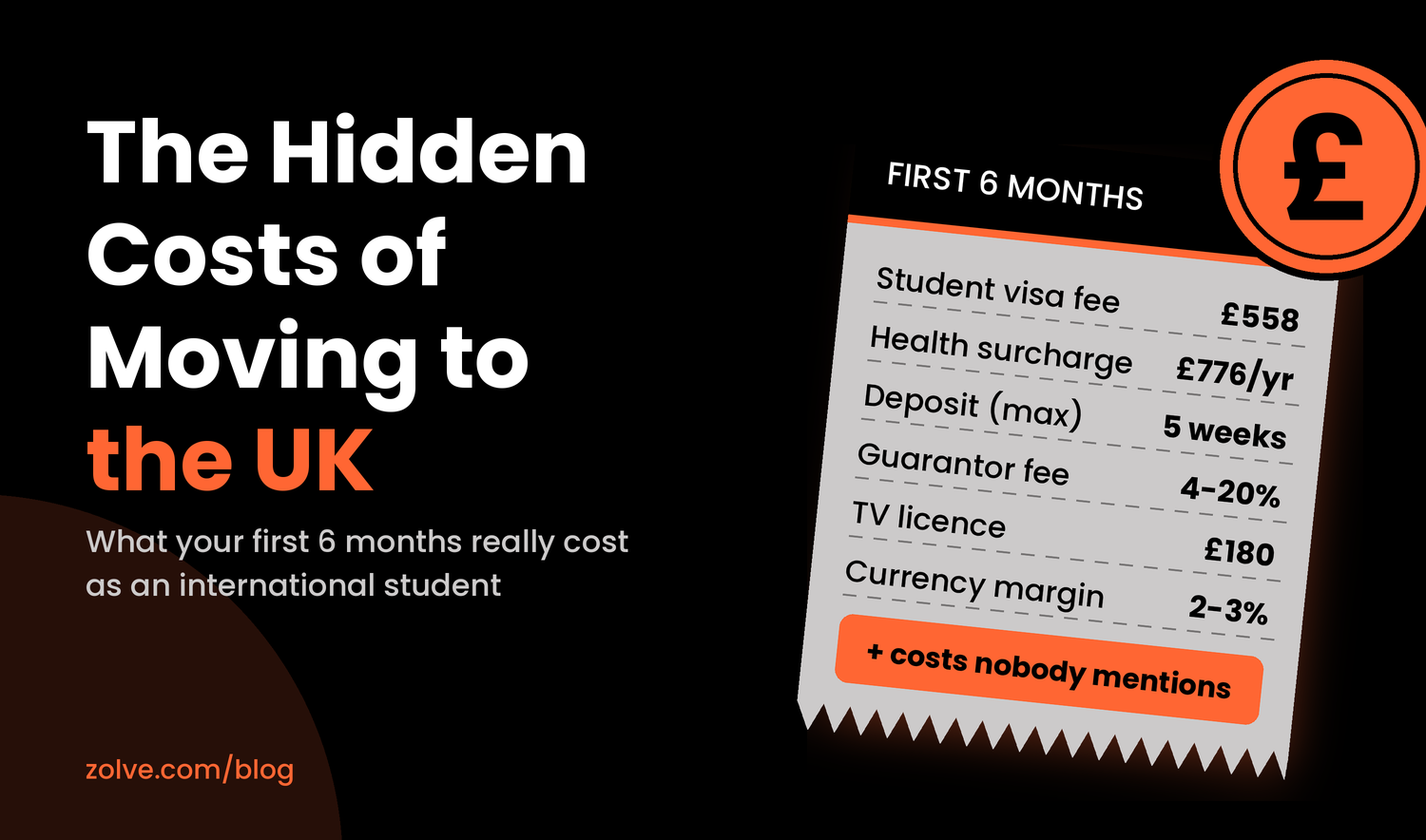
| Student visa fee rose from £524 to £558 | Higher upfront cost for every applicant | From 8 April 2026 |
| IHS for students unchanged at £776 a year | Still the biggest visa-related line item | Unchanged in 2026 |
| Fixed living-cost requirement: £1,171 (outside London) or £1,529 (London) a month | Set by the Home Office, not your university | In force since 11 November 2025 |
| Renters' Rights Act: max 1 month rent in advance, no bidding wars, rolling tenancies | Cheaper move-in, but guarantor rules matter more | From 1 May 2026 (England) |
| TV licence rose to £180 | Needed if you watch live TV or BBC iPlayer | From 1 April 2026 |
| National Living Wage (age 21 and over) rose to £12.71 an hour | Better part-time pay | From 1 April 2026 |
| Graduate visa shortens to 18 months for bachelor's and master's graduates | Less time to job-hunt after study | Applications from 1 January 2027 |
| Planned levy on English universities' international fees (about £925 per student) | May influence future tuition pricing | Expected from August 2028 |
A quick myth-buster: you may see websites claiming the 28-day funds rule has been cut to 14 days. The official GOV.UK Student visa page still states 28 days, with the 28-day window ending within 31 days of your application.
Stage 1: Before you fly (the official costs)
1. The visa application fee
The Student visa costs £558 if you apply from outside the UK, and the same if you extend or switch from inside the UK. You can apply up to 6 months before your course starts, and decisions usually take about 3 weeks.
2. The Immigration Health Surcharge (IHS)
This is a separate payment that gives you access to the NHS. Students and their dependants pay £776 per year. You pay the whole amount upfront, and it is based on your visa length, not just your course length.
The part-year rule is the part most people miss. Any part-year of 6 months or less is charged at £388, and anything over 6 months is charged as a full year.
3. Your total upfront visa cost
| Item | One-year master's |
|---|---|
| Student visa fee | £558 |
| IHS (visa of about 16 months) | £1,164 |
| Total | £1,722 (about ₹2.2 lakh) |
Add optional extras if you need speed: priority services have been reported at £500 or £1,000 extra per applicant, so confirm current options on GOV.UK.
4. The TB test (For applicants from India and other listed countries)
If you are coming for more than 6 months from a country on the Home Office list, you need a tuberculosis test at an approved clinic. India is on that list, and GOV. UK publishes the approved clinics and their fees. Fees are usually a few thousand rupees, and only clinics on the official list are accepted, so check the official page before you pay anyone.
5. The big one: proof of funds
You need to show your first-year tuition (less anything already paid) plus living costs. The living-cost figures are fixed by the Home Office:
| Where you study | Per month | Months counted | Living funds to show | Approx. in INR |
|---|---|---|---|---|
| Outside London | £1,171 | up to 9 | £10,539 | ₹13.5 lakh |
| London | £1,529 | up to 9 | £13,761 | ₹17.6 lakh |
Each dependant adds more. Funds must be held for 28 days in a row, with the end date within 31 days of your application. Money tied up in a fixed deposit that you cannot access freely may not count, so read the GOV.UK financial evidence guidance before you move anything.
Example: a one-year master's outside London with £18,000 tuition and nothing paid yet needs £28,539 in evidence (£18,000 plus £10,539).
If you are planning to fund your studies with a loan, a sanction letter is treated differently from savings. Zolve's guide to education loans for studying abroad from India compares lenders and shows typical overall study costs for popular destinations, including the UK, which helps you plan both sides of the equation.
Stage 2: Landing week
Accommodation: the biggest first-week shock
Rent is usually the largest monthly cost. According to Save the Student's 2026 data, the average student rent is around £529 a month, while the NatWest Student Living Index 2025 puts the national average at about £562.67. Big cities, especially London, sit well above that.
What you pay on move-in depends on where you live:
| Housing type | Typical upfront payment | Watch out for |
|---|---|---|
| University halls | Deposit or first instalment set by the university | Instalment dates, catered vs self-catered |
| Purpose-built student accommodation (private halls) | Deposit plus first payment | Not covered by the Renters' Rights Act, so contract terms vary |
| Private rental (England) | Holding deposit (max 1 week), deposit (max 5 weeks), first month's rent | Guarantor demands, agent scams |
What the 2026 law change means. Since 1 May 2026, landlords in England cannot require more than one month's rent upfront, can only accept the advertised rent (no bidding), and deposits stay capped at 5 weeks' rent when annual rent is under £50,000. Tenancies are now rolling (periodic) instead of fixed-term. Wales, Scotland and Northern Ireland have their own rules, so check locally.
The trade-off nobody mentions. Before this change, international students without a UK guarantor often paid several months of rent in advance. Now that is restricted, but landlords still want security. Students' unions warn that this puts more pressure on students to find a guarantor, and professional guarantor services may charge roughly 4% to 20% of total rent. On £7,200 of annual rent, that is about £288 to £1,440. Some universities run their own rent guarantor schemes, so ask yours before you pay a private company.
Illustration. On a £600 monthly rent, 5 weeks' deposit is about £692, plus £600 for the first month. That is roughly £1,292 on day one, before groceries or a SIM card.
Banking and cash
- Do not carry large cash. One university advises bringing no more than £500 to £700 in small notes, and you must declare cash of €10,000 or more when crossing the border.
- Opening an account takes paperwork. Banks usually want your passport, visa, a student status letter from your university and a UK address. Some let you start the application from abroad, which saves time.
- Tuition cannot be paid in cash, so plan transfers early.
Setup items people forget
Bedding for a UK winter, adapters, kitchen basics, a coat, a SIM card, and transport top-ups all arrive in the first fortnight. A reasonable allowance is £150 to £300 depending on whether your room is furnished. These are estimates, not official figures.
Stage 3: Months 1 to 3
Monthly living costs
NatWest's 2025 index shows where student money goes after rent: groceries around £146.76 a month, household bills around £124.08 and clothing around £123.30. A typical night out is estimated at around £30. If your bills are not included in your rent, budget for gas, electricity, water and broadband separately.
Council tax: Usually £0, if you claim it
Full-time students are generally exempt from council tax, and international students are treated the same way as home students. You need a Council Tax exemption certificate from your university, which you send to your local council. If you live with non-students, the household may still get a bill, so sort this out in writing with your housemates.
TV licence
You need a licence if you watch or record live TV or use BBC iPlayer. It rose to £180 a year from 1 April 2026. If you only stream on-demand services other than iPlayer, you may not need one, but check the rules before you decide.
Healthcare: Covered, but not everything is free
Paying the IHS gives you NHS access similar to a UK resident, including GP and hospital care. Some services, such as dental care and, depending on the UK nation, prescriptions, can still carry charges. Register with a local GP early rather than waiting until you are unwell.
Transport
Costs vary hugely by city. A monthly bus pass outside London looks very different from London Tube zones, and rail travel between cities is expensive without a railcard. Budget around £40 a month as a starting point for local travel, then adjust once you know your daily commute. This is an estimate, not a fixed rate.
Stage 4: Months 4 to 6
Part-time work: Helpful, but limited
On a Student visa at degree level, you can generally work up to 20 hours a week in term time and full-time in official vacations, but your own visa's conditions are what count. Going over your limit can put your visa at risk.
At the National Living Wage of £12.71 an hour (age 21 and over), 20 hours a week is about £254 gross per week. Over a 12-week term that is roughly £3,050 before tax, assuming you actually find a job quickly, which many students do not in the first months. Do not budget for work income until you have a contract.
Currency transfers
Banks commonly add a 2% to 3% margin on international transfers on top of any fee. On £8,500 sent over six months, that is about £170 to £255 lost before you spend a pound. Compare the final amount received, not just the headline fee, and consider fewer, larger transfers when the rate is good.
Scams: A real cost
NatWest found that student scam victims lose an average of £287.60. Common traps include holding deposits requested before a viewing, "agents" who vanish, and pressure to pay by WhatsApp. A holding deposit is legally capped at one week's rent in England, and you should never pay for a property you have not seen or checked through your university's accommodation service.
Social life
Nights out, takeaways, trips and society fees are easy to underestimate. Set a weekly cap and track it, because this is the category most students overspend in.
Six-month budget
This table assumes a one-year master's student outside London, in a shared private room at £600 a month. Replace the estimates with your own city's numbers.
| Item | Amount | Basis |
|---|---|---|
| Student visa fee | £558 | GOV.UK |
| IHS (about 16 months of visa) | £1,164 | GOV.UK rate |
| TB test | about £35 | Estimate (varies by clinic) |
| Rent (6 months at £600) | £3,600 | Estimate |
| Security deposit (5 weeks, refundable) | £692 | Legal maximum |
| Bills (about £124 a month) | £744 | NatWest 2025 average |
| Groceries (about £147 a month) | £881 | NatWest 2025 average |
| Mobile (about £15 a month) | £90 | Estimate |
| Local transport (about £40 a month) | £240 | Estimate |
| Setup essentials | £225 | Estimate |
| Social and eating out (about £100 a month) | £600 | Estimate |
| Currency transfer margin | £210 | About 2.5% of transfers |
| Total (excluding tuition, flights, TV licence) | about £9,039 |
A useful sanity check: your living spend here works out to roughly £1,060 a month after removing the refundable deposit and one-off setup items. That sits just under the Home Office figure of £1,171 for outside London, so the official number is a fair guide only if you budget carefully. In London, the £1,529 figure is a floor, not a comfortable budget.
Money-saving checklist
- Apply for your visa as early as allowed, and gather bank statements well ahead of the 28-day window.
- Ask your university about a rent guarantor scheme before paying a private guarantor service.
- Choose halls for your first year if you are new to the UK. Fewer surprises, fewer scams.
- Claim your council tax exemption the week you enrol.
- Compare the final amount received on every currency transfer.
- Keep a separate emergency buffer of at least one month of rent.
- Track every pound for the first 30 days. It reveals your real spending pattern quickly.
- Use student discounts such as an ISIC card, university deals, and railcards where they pay off.
For more day-to-day money habits that work in any country, see Zolve's financial hacks for a smooth study abroad experience.
Moving as a working professional or with a family
If you are heading to the UK on a work visa rather than a Student visa, the same logic applies with different numbers. Most work routes pay the IHS at £1,035 per adult per year, paid upfront for your full visa length, so a family of four on a long visa can pay thousands before arrival. Rental rules, deposits, council tax (which you will pay) and TV licensing apply to you too, and without student exemptions your monthly outgoings are higher. Always check your specific route's fees on GOV.UK.
Planning past month 6
The Graduate visa lets you stay and work or look for work after your degree. GOV.UK states it lasts 2 years if you apply on or before 31 December 2026, and 18 months if you apply on or after 1 January 2027. PhD graduates keep 3 years.
For most students starting this autumn, you will graduate in 2027, which means 18 months. The Graduate visa IHS is £1,035 a year, so an 18-month permission would cost about £1,552.50 in surcharge. Settlement rules are also under review, so keep an eye on official announcements. The practical advice: start your job search in month one, not month twelve.
FAQs
How much money do I need for my first 6 months in the UK as an international student? For a one-year master's outside London, plan for about £9,000 beyond tuition and flights, including visa costs. London will be significantly higher.
Is the Immigration Health Surcharge refundable? It is usually refunded only if your visa is refused or in a few specific circumstances. Check the GOV.UK IHS page for current refund rules before you apply.
Do I need a UK bank account before I arrive? Not necessarily, but you will want one within your first few weeks. Some banks let you start the application from abroad, and your university can usually provide a bank letter once you enrol.
Can I work while on a UK Student visa? Yes, if your visa allows it. Degree-level students can generally work up to 20 hours a week in term time and full-time during official vacations, but your visa conditions are final.
Will my deposit be safe? Landlords in England must protect your deposit in a government-approved scheme. Take dated photos at move-in and keep copies of everything.
What if I do not have a UK guarantor? Ask your university first, since some run guarantor schemes. If you use a commercial service, compare the fee as a percentage of rent before you sign.
The bottom line
The UK is still a brilliant place to study, but the headline tuition number tells you maybe 70% of the story. The remaining 30%, in the form of visa charges, deposits, guarantor fees, bills and currency losses, is where budgets break. Plan for it early, verify numbers on official government pages, and build a cushion. Future you, standing in a UK supermarket in January, will be grateful.