Quick Summary
- Open an account early, but expect limits. Opening before you land can help, yet many providers still want a UK address or UK residency.
- Your core documents: passport, proof of immigration status (eVisa share code or BRP), university offer or CAS details, and a UK address.
- BRP cards are on their way out. Existing BRPs can create a UKVI account until 31 December 2026, or 24 months after expiry, whichever is first.
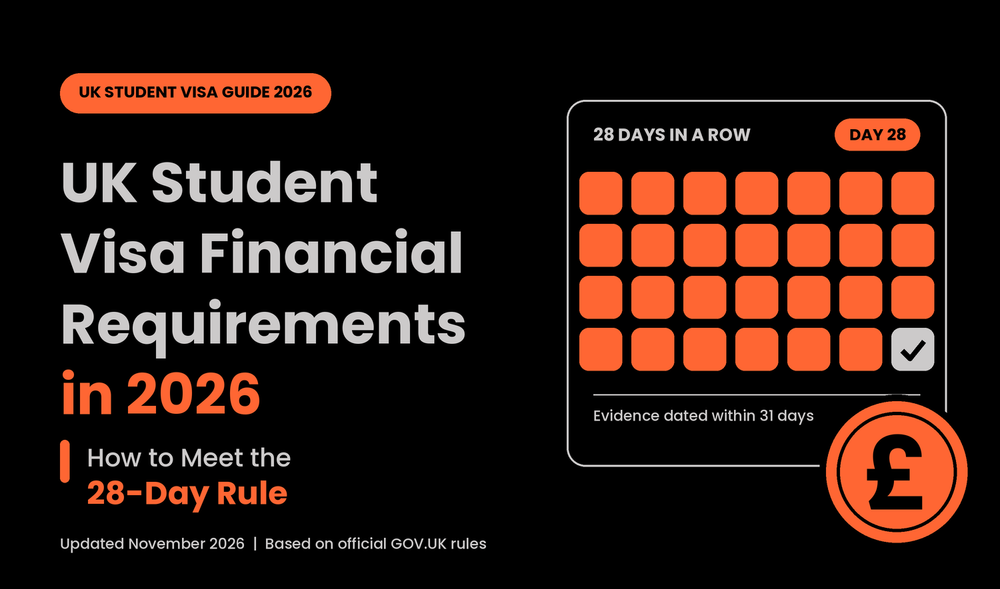
- Visa funds figures: £1,529 a month in London, £1,171 elsewhere, for up to 9 months, held for 28 days.
- Your deposits are protected up to £120,000 per person, per authorised institution since 1 December 2025.
- Two account types to pair: A UK current account for rent, wages and daily spending, plus a low-cost transfer option for money from home.
- Work rules affect banking: degree-level students can work up to 20 hours a week in term time, and wages need a UK account.
- Graduate visa change: 18 months instead of 2 years for applications from 1 January 2027.
- Scams target new arrivals. Fake Home Office, police, and tuition fee calls are common.
Why a UK bank account is one of your first jobs
A UK bank account is the practical centre of student life in Britain: rent, utilities, a part-time wage, a phone contract and even a gym membership usually run through one. It is also where many students park their visa funds, so the way you set it up before and after landing matters.
The tricky part is a loop that catches almost every newcomer. Banks want proof of a UK address, but landlords and universities want your money sorted first. Most guides stop at "take your passport to a branch". This one walks through what to prepare from home, what to do in your first two weeks, and how the 2026 rules around eVisas, share codes, and the Graduate visa change the picture.
The numbers that shape your plan
| What | Figure |
|---|---|
| Visa funds, London | £1,529 a month, up to 9 months |
| Visa funds, outside London | £1,171 a month, up to 9 months |
| How long funds must be held | 28 days in a row, ending within 31 days of applying |
| Share code validity | 90 days |
| Deposit protection | £120,000 per person, per institution |
| Term-time work, degree level | Up to 20 hours a week |
| Graduate visa length | 2 years if you apply by 31 December 2026, 18 months from 1 January 2027 |
Some blogs claim the 28-day funds rule has been cut to 14 days. As of 17 November 2026, the gov.uk page still says 28 days, so plan for 28 and check the page again before you apply. Our own explainer on the 28-day rule for the UK student visa covers how to line up your funds.
1. Get your immigration paperwork in order
Banks must check that you have permission to be in the UK, so your status evidence is the first thing they ask about.
- New applicants no longer receive a BRP. BRP production stopped after 31 October 2024, and your status now sits in an eVisa on your UKVI account.
- Create and check your UKVI account early. You use it to view your eVisa and to generate a share code.
- If you hold a BRP, you can still use it to create a UKVI account until 31 December 2026 or 24 months after it expires, whichever comes first. Keep the card even after it expires.
- Keep your passport details current in the account. UKCISA advises keeping your passport and contact details updated so your records match what you show the bank.
2. Prepare your document pack
Document | Why a bank wants it | Tip |
|---|---|---|
Valid passport | Photo ID and name check | Use the exact name on your visa and CAS |
eVisa share code or BRP | Proof you may live and study in the UK | A share code lasts 90 days, so generate it close to your application |
University offer or CAS details | Shows you are a genuine student | Keep a PDF copy on your phone |
Letter of introduction or enrolment letter | Helps with anti-money-laundering checks | Ask your international office; UKCISA says your institution may provide one |
UK address | Needed by most providers | Halls tenancy, private tenancy or a university letter |
Phone number and email | App sign-up, security codes | Use a number you can reliably access for security codes |
Proof of funds (separate) | For your visa, not the bank account | See the gov.uk figures above |
If you lack standard documents, banks should accept alternatives such as an immigration status document or a letter from your place of study. Each bank sets its own rules, so check its published list before you go.
3. Line up money for the first weeks
Even with a UK account ready, funds may take days to reach it. Carry a way to pay for the essentials from day one:
- A debit or forex card from your home bank with international use enabled
- Enough local-currency cash to cover transport from the airport and a few days of food
- A tested international transfer route set up before you fly
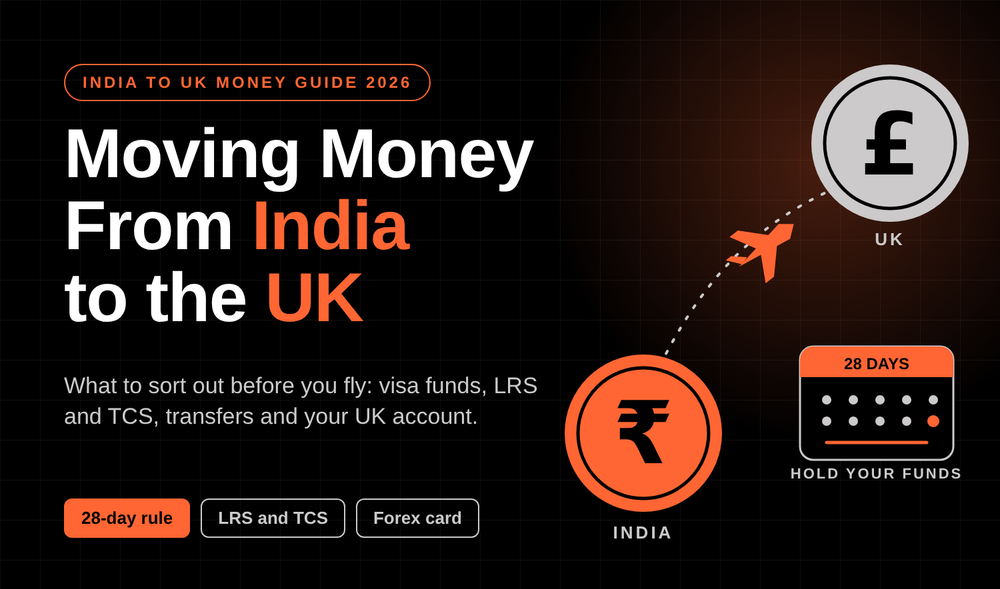
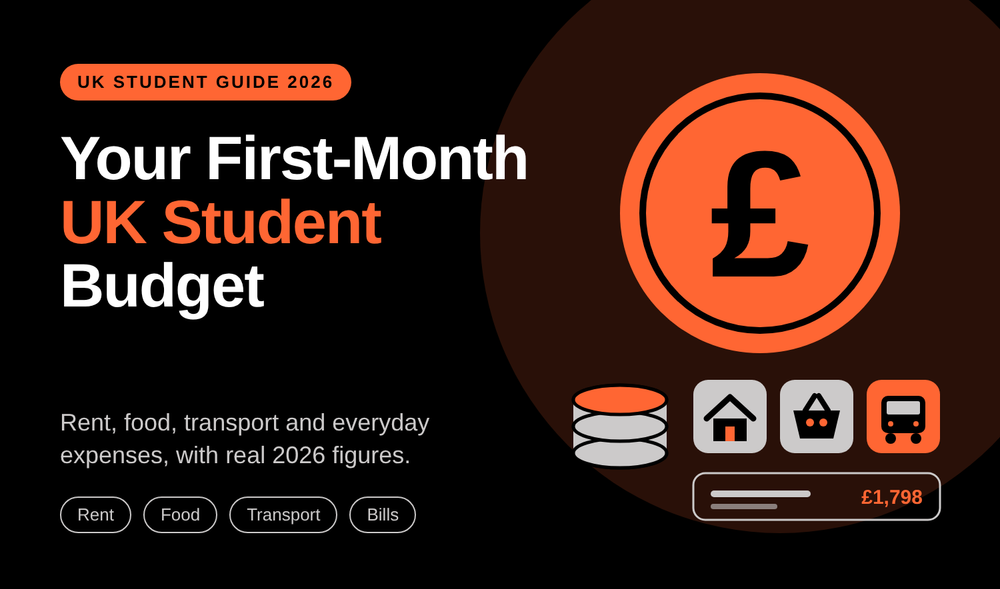
Our guide on moving money from India to the UK explains how to plan the transfer, and the real cost of moving to the UK helps you size the amount.
4. Shortlist your banks before you land
Compare providers on independent sites, then check each bank's own eligibility page. Ask your university too: several publish partner bank lists and arrival-week banking sessions.
After you arrive: Opening your account step by step
- Generate a fresh share code. Use the gov.uk 'View and prove' service. You need your UKVI sign-in details and access to the phone or email you registered. The code lasts 90 days and can be reused until then. Gov.uk names employers and landlords as typical recipients, so ask your chosen bank which status evidence it accepts rather than assuming.
- Collect your proof of address. A tenancy agreement or university accommodation letter is the usual starting point. Documents are generally expected to be dated within 3 months, and some providers reject mobile phone bills.
- Request a letter from your university. Ask the international or student services team for an enrolment or bank introduction letter. UKCISA says banks may also contact your institution to confirm your student status.
- Apply with your top choice. Digital banks use an in-app ID and selfie check. High-street banks may offer branch appointments, and many universities arrange on-campus banking sessions in the first weeks.
- Set up the basics. Add the card to your phone wallet, switch on transaction alerts, and note your sort code and account number for your landlord and employer.
- Keep the account active. If you will be away for a long break, tell the bank so it does not treat the account as dormant and close it.
- Update your details when you move. Tell your bank promptly about any change of address, and keep copies of your correspondence.
Which account will you actually be offered?
Banks run anti-money-laundering and immigration checks, so approval is never guaranteed. UKCISA notes that basic accounts usually have no overdraft, while some international student accounts offer a limited one. If one application is declined, ask the bank for the reason, check that your name and address match across documents, and then try a provider with different eligibility rules instead of reapplying repeatedly.
Moving as a working professional?
The steps are nearly identical, but your strongest supporting documents change. An employer letter or contract alongside a visa as newcomer evidence, and your employer will need UK account details to pay you. Ask HR whether they can provide a letter confirming your start date and salary, because it can support your application until you have a tenancy. Confirm with your bank that it accepts this.
Choosing the right account type
You will usually pick from four kinds of accounts. Most students end up with a UK current account plus a separate route for money from home.
Account type | Best for | What to check first |
|---|---|---|
Basic bank account | Rent, wages, bills with no frills | |
International student account from a high-street bank | Students who want a branch and a UK address-backed relationship | Whether you need a UK address and a university letter |
Digital (app-only) bank | Fast sign-up and spending controls | UK address or residency rules, and whether eVisa checks are supported |
Multi-currency or transfer account | Receiving money from family and paying fees | Exchange rate margin, transfer fee and limits |
What the sources say about specific providers
Provider | Type | Point worth knowing |
|---|---|---|
Starling | App-only | Student account with a £500 interest-free overdraft, subject to verification and at least two years of study remaining |
Monzo | App-only | Requires UK residency under its own terms |
HSBC | High street | Offers an international student account |
Lloyds | High street | Classic account accepts international students |
Santander | High street | Basic account accepts international students |
TSB | High street | Spend & Save account accepts international students |
Revolut | Challenger | Multi-currency, generally needs a confirmed UK address |
Monese | Challenger | Described as not needing UK credit history or immediate UK address proof |
The same guide leaves out Barclays, NatWest and Nationwide, so check those too if you want the full market.
Fees, exchange rates and sending money
UK current accounts are mostly free to run, so the real cost for international students sits in currency conversion. When you compare options, look at three things together rather than the headline fee alone:
- The exchange rate margin against the mid-market rate you see on a search engine
- The fixed transfer fee, if any, on each payment
- Speed and limits, especially around tuition fee deadlines and rent due dates
On the tuition side, universities often publish their own approved payment routes, so use those rather than a third party offering a discount. See the scams section below for why.
How safe is your money?
UK banks, building societies and credit unions authorised by the PRA are covered by the Financial Services Compensation Scheme. The limit rose to £120,000 per depositor, per institution, on 1 December 2025. Providers that share one banking licence share one limit, so check who holds the licence before you split savings across apps.
Work, credit history and staying safe
Working while you study
A UK account is what makes part-time work practical. According to UKCISA:
- Degree-level students at a sponsor with a track record can work up to 20 hours a week in term time. Below degree level, the cap is 10 hours.
- A week means any seven-day period starting on a Monday.
- You can work full time outside term time, including vacations and the period before your course starts.
- Unpaid voluntary work counts toward your weekly hours, and part-time postgraduates may not work at all.
- Keep records of your hours, especially with more than one employer.
After your degree: The Graduate visa change
The Graduate visa lasts 2 years if you apply on or before 31 December 2026, and 18 months if you apply on or after 1 January 2027. PhD graduates get 3 years. The government is exploring an international student levy on university income, which would need legislation. Keep your account and address history tidy, because later visa applications can ask you to evidence your finances.
Building credit history
Credit history takes time to build in the UK. Most high-street banks expect around three years of UK residency before offering a credit card. In the meantime:
- Pay rent and bills on time from your UK account
- Register for the electoral roll once you are eligible, and keep your address consistent
- Avoid applying for several credit products in a short window
Scams that target new arrivals
Scam | How it works | Safe response |
|---|---|---|
Fake police or embassy call | Claims you are linked to money laundering and demands payment | Hang up and contact your university |
Fake Home Office or UKVI message | Demands an immediate fine for a visa problem | Check only through your UKVI account |
Tuition fee discount | Offers a lower fee if you pay through a third party using a stolen card | Pay only through your university's official channel |
Fake NHS records call | Threatens loss of NHS access, then asks for money | Ignore and report it |
Fake job email | Asks you to pay for "equipment" up front | Never pay to start a job |
AI voice cloning | Mimics your voice to ask family for money | Agree a family code word |
The rule across all of them, in Manchester's words: it is fine to reject, refuse or ignore any request, because only criminals will try to rush or panic you.
Your banking timeline and checklist
When | What to do |
|---|---|
3 to 4 months before | Confirm funds against the gov.uk figures and check how long they must be held. Create your UKVI account once your visa is granted |
1 to 2 months before | Shortlist two or three banks, read their eligibility pages, and ask your university for partner bank details and a letter template |
2 to 4 weeks before | Test your international transfer route, enable international use on your home card, and save PDFs of your documents |
Arrival week | Collect your tenancy details, generate a fresh share code, and attend any university banking session |
Weeks 1 to 2 | Apply for your main account, set up alerts, share account details with your landlord and employer |
Month 1 | Set a budget, confirm rent and bills are paid on time, and check for any unexpected fees |
Every term | Review exchange rates and transfer costs, and update your address if you move |
Common mistakes to avoid
The pitfalls below come from the guidance and community threads reviewed for this article, not from a count of social posts.
- Applying before you have an address. Most providers need one, and a Monzo community thread notes the UK address and residency requirement.
- Using an expired share code. It lasts 90 days, so generate a new one when you apply.
- Assuming the first decline is final. Each bank sets its own criteria. MoneyHelper advises asking staff to check the published alternatives if you are refused.
- Opening an account only for the sign-up bonus. Ongoing benefits matter more than one-off switching offers, which ClearScore describes as volatile.
- Ignoring the currency conversion cost. The transfer margin often outweighs any monthly fee.
- Paying tuition through an unofficial route. Discount offers are a known scam pattern.
Frequently asked questions
Can I open a UK bank account before I arrive? Sometimes. UKCISA says it may be beneficial, but many providers need a UK address or UK residency, so check each one.
Do I need a BRP? New applicants do not receive one. Status is held in an eVisa you view through your UKVI account.
What is a share code? A code that lets someone check your immigration status without seeing your documents. It lasts 90 days.
Is a student account better than a basic account? It can be, if it offers an overdraft you will use. UKCISA notes basic accounts usually have none. Compare terms and eligibility first.
Can I get a UK credit card straight away? Unlikely. ClearScore says most high-street banks expect about three years of residency.
How much money do I need to show for my visa? £1,529 a month in London and £1,171 elsewhere for up to 9 months, plus course fees as shown on your CAS.
How safe is money in a UK bank? Up to £120,000 per person, per authorised institution, is covered by the FSCS.