If your post-completion OPT card is about to expire and you hold a STEM degree, the next 90 days decide whether you keep working without interruption or end up with an illegal employment gap that can derail your career and your status. The STEM OPT timeline is unforgiving by design: USCIS will not accept a 24-month extension application that arrives even one day after your current EAD expires.
This guide breaks the entire process into a clear countdown, explains the latest 2026 fees and processing realities, and tells you exactly what to do at the 90, 60, and 30-day marks before your Employment Authorization Document (EAD) runs out.
Latest Developments Around OPT as of July 2026
If you are currently in the U.S. under the standard "Duration of Status" (D/S) system, you can file your Form I-765 for a STEM OPT extension up until March 18, 2027. You will not have to submit a separate Form I-539 for extension of stay.
If you travel internationally after September 15, 2026, and re-enter the U.S. before submitting your STEM extension, Customs and Border Protection (CBP) will issue you a fixed-date I-94. If that happens, you will be forced to file both the Form I-765 and a Form I-539 EOS application concurrently.
Impact of New Rules for Duration of Stay on OPT extension
Quick Notes
- Open your filing window at 90 days: You can submit Form I-765 to USCIS as early as 90 days before your current post-completion OPT EAD expires, and no later than the EAD expiration date itself. You must also file within 60 days of your DSO entering the STEM OPT recommendation in SEVIS, and you must be physically in the United States when USCIS receives your application.
- Costs in 2026: Form I-765 is $470 online or $520 by paper. Optional premium processing (Form I-907) jumped to $1,780 for any filing postmdsarked on or after March 1, 2026.
- Premium processing timeline: 30 business days for USCIS to act, then about 1 to 2 weeks for the physical card. It speeds up the officer review, not the card printing.
- Standard processing in 2026 runs long: Realistically, expect 3 to 5 months, and budget for the possibility of a longer wait given the 2026 backlog that has left thousands of students waiting.
- Two non-negotiables: Your employer must be enrolled in E-Verify, and you must complete Form I-983 (Training Plan) before your DSO can issue the STEM-recommended I-20.
- The golden rule: Apply as early in the 90-day window as you can. Early filing is your cheapest insurance against delays.
What is STEM OPT Extension?
Optional Practical Training is temporary work authorization for F-1 students, not a visa. Standard post-completion OPT gives most graduates 12 months of work authorization in a field related to their major. If your degree is on the DHS STEM Designated Degree Program list, you can apply once for a 24-month extension, bringing your total to 36 months of OPT.
You cannot get all 36 months up front. You first use your 12-month OPT, and then, in the final stretch of that period, you file for the STEM extension. Here are a few facts worth anchoring before we get into the countdown:
- The extension is 24 months, used one time per higher degree level (so a separate STEM-eligible bachelor's and master's can each support one extension).
- Your employer must be enrolled in E-Verify and must have a real, paid, bona fide employer-employee relationship with you, for at least 20 hours per week, directly related to your STEM field.
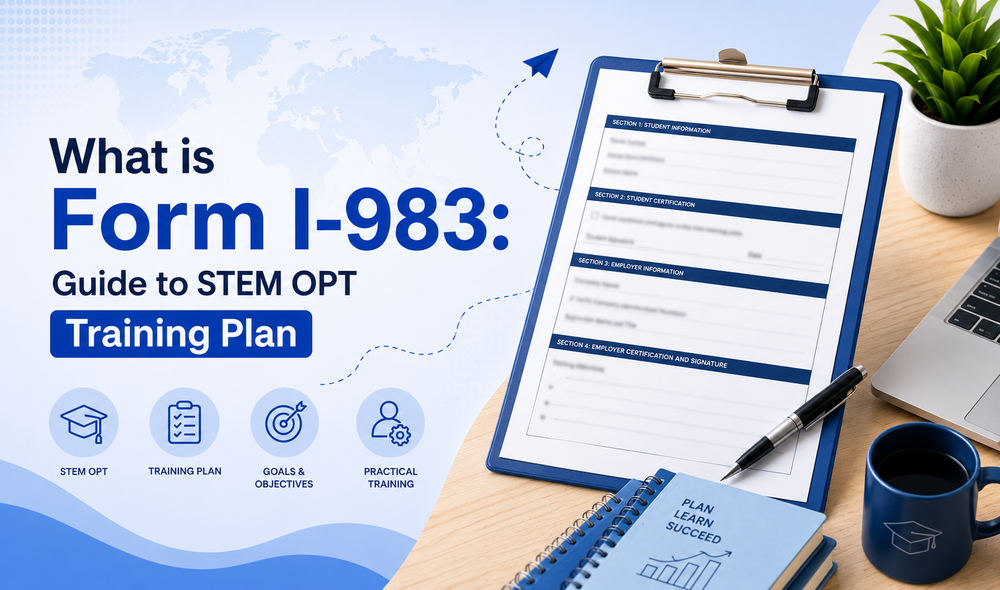
- Form I-983, the Training Plan, is the document that separates STEM OPT from regular OPT. You and your employer complete it, and you submit it to your DSO (not to USCIS).
- Your total unemployment cap is 150 days across the entire 36-month OPT period: 90 days during initial OPT plus an extra 60 days unlocked by the STEM extension.
STEM OPT Extension Timeline at a Glance
Here is the full countdown, anchored to the expiration date printed on your current OPT EAD card.
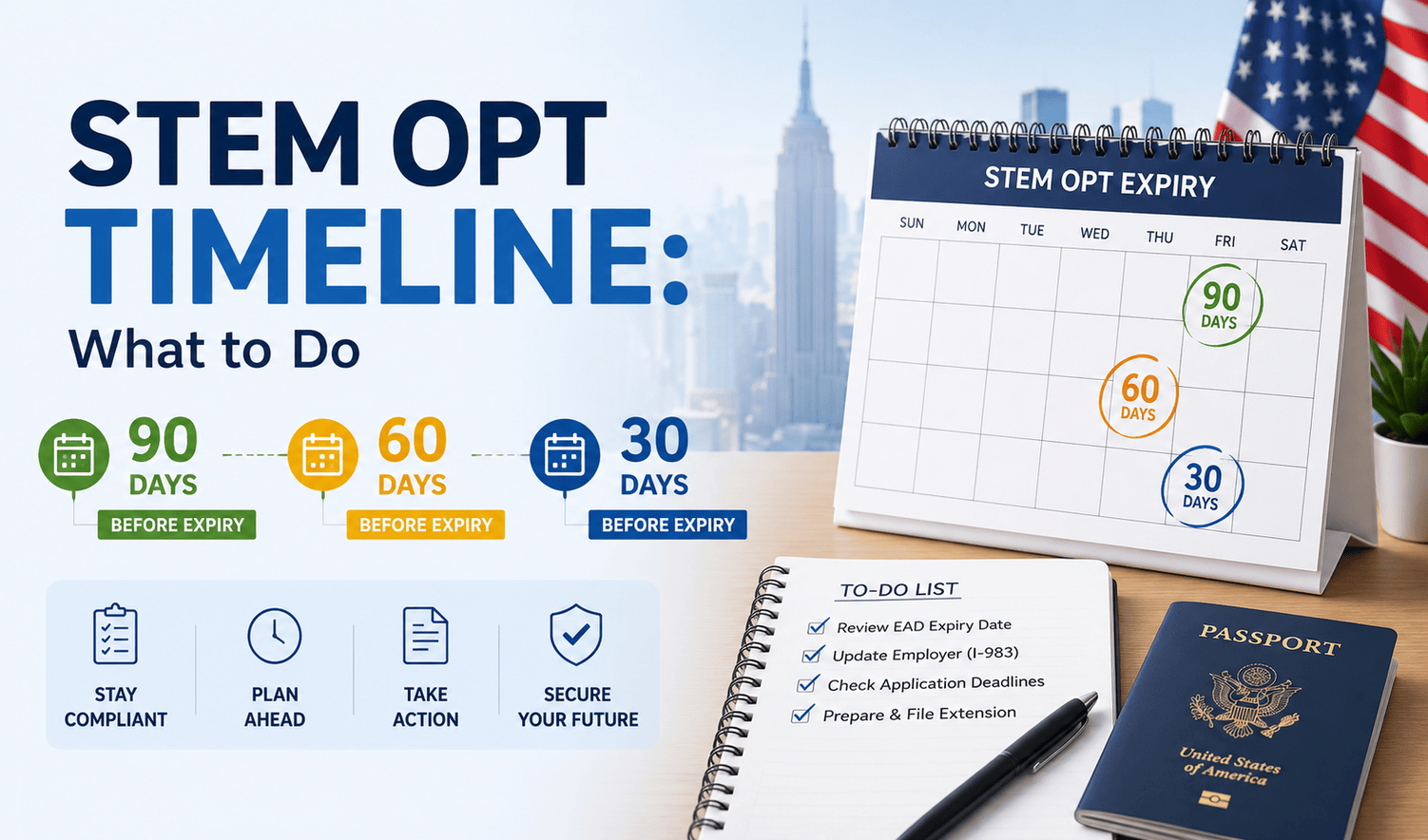
90 Days Before Expiry: Open the Window and File
The single most important date in the entire STEM OPT extension timeline is 90 days before your current EAD expires. This is the earliest USCIS will accept your Form I-765, and it is the moment you should be ready to act.
The three filing conditions you must satisfy
To be "properly" or "timely" filed, all of the following must be true:
- USCIS receives your Form I-765 up to 90 days before your post-completion OPT EAD expires and no later than the expiration date on that card.
- USCIS receives it within 60 days of the date your DSO entered the STEM OPT recommendation into your SEVIS record.
- You are physically present in the United States when USCIS receives the application.
A practical note for online filers: USCIS uses Coordinated Universal Time (UTC) to date-stamp e-filed applications. If you are filing close to your deadline, check the UTC time, not just your local clock, so you do not accidentally cross your expiration date.
Your 90-day action checklist
- Get Form I-983 signed: You and your employer complete the Training Plan. Without it, your DSO cannot issue the STEM-recommended I-20.
- Request your STEM OPT I-20: Submit the completed I-983 to your DSO and ask for the updated I-20 with the STEM OPT recommendation on page 2. This typically takes a few business days to a couple of weeks depending on your school.
- File Form I-765 online (recommended) through your myUSCIS account using the current form edition.
- Sign the I-20 in ink on the student attestation line before you upload it.
- Pay the fee: $470 online or $520 by paper.
Documents to have ready
- Form I-765
- I-20 endorsed by your DSO with the STEM OPT recommendation, dated within the last 60 days, signed by you in ink
- A copy of your STEM degree (diploma or transcript showing the conferred degree)
- Your employer's E-Verify Company Identification Number or valid E-Verify Client Company ID Number
- Passport-style photos meeting USCIS specs, plus copies of your passport, I-94, and prior EAD cards
Remember: the I-983 goes to your DSO, not to USCIS. USCIS wants the STEM-recommended I-20, the degree copy, and the E-Verify number that proves your employer qualifies.
60 Days Before Expiry: The Catch-Up and Compliance Checkpoint
If you are reading this at the 60-day mark and have not filed yet, treat it as a deadline, not a suggestion. Two clocks are now running against each other.
The first is the 90-day-to-expiry clock. The second is the 60-day DSO recommendation clock: USCIS must receive your STEM OPT application within 60 days of the date your DSO entered the STEM recommendation in SEVIS. If your DSO recommended you early in your 90-day window, that recommendation can effectively "expire" for filing purposes if you stall. If you are bumping up against it, your I-20 may need to be re-issued with a fresh recommendation date, which costs you precious time.
Your 60-day action checklist
- File now if you have not: Every day you wait shrinks your buffer against processing delays.
- Confirm your DSO recommendation date: Make sure your filing will land inside the 60-day window measured from that date.
- Verify your receipt notice arrived: USCIS usually issues the I-797C receipt within 2 to 3 weeks of receiving the application (faster, often 3 to 5 business days, for online filings). This receipt is your legal proof of timely filing and the document that unlocks the 180-day extension.
- Save everything: Keep copies of the I-20, the I-765 submission, the payment confirmation, the receipt notice, and every USCIS notice in one folder.
- Do not travel internationally: While your case is pending if your OPT EAD has already expired, without first consulting your DSO and, ideally, an immigration attorney do not venture out on an international trip. Re-entry during the 180-day interim period is a documented risk area.
This is also the right moment to decide whether premium processing makes sense, which we cover in detail below.
30 Days Before Expiry: The Last Safe Zone
By 30 days out, your application should already be filed and receipted. If it is, this window is about managing the gap and your employer's expectations. If it is not filed yet, you are in the danger zone, and filing should be your only priority today.
If you have filed and have your receipt
You are in good shape. Here is what to do:
- Understand the 180-day rule: Because you timely filed, your work authorization is automatically extended for up to 180 days beyond your EAD expiration date, or until USCIS makes a decision, whichever comes first. You can keep working on your expired EAD card plus your I-797C receipt notice.
- Brief your employer early: This has become part of the filing strategy in 2026. Give your HR or manager a copy of your I-797C receipt notice and explain the I-9 implications well before your EAD's printed expiration date, so payroll and onboarding do not stall on a misunderstanding.
- Correct the common myth. Some employers wrongly believe the 180 days is an "automatic EAD extension" that STEM students do not qualify for after the October 2025 rule change. They are conflating two different things. The STEM OPT 180-day continued employment is granted on the basis of a timely filed I-765 under its own regulation, and it remains in effect.
If you have NOT filed yet
- File today, online, to get the fastest possible receipt date stamp.
- Contact your DSO immediately to confirm your I-20 recommendation is current and within its 60-day window.
- If your card is days from expiring and your I-20 is not ready, escalate with your DSO right away. Missing the expiration date means you lose STEM OPT eligibility entirely. There is no grace period for late STEM filings.
What you cannot do at the 30-day mark?
You cannot rely on a job offer, a signed offer letter, an OPT recommendation on your I-20, or even a pending I-765 as work authorization on their own. Employment can only begin or continue when authorization is valid, which for STEM extension applicants means a timely filed application plus the receipt notice, or an approved new EAD.
STEM OPT Premium Processing Timeline and Whether It Is Worth It
Premium processing has been available for F1 OPT and STEM OPT I-765 filings since 2023. It is optional, and in 2026 it has become expensive, so it deserves a clear-eyed look.
How the STEM OPT premium processing timeline works?
- You file Form I-907 either together with your I-765 or as an upgrade after your I-765 is already pending and receipted.
- USCIS guarantees it will take some adjudicative action (approval, denial, request for evidence, or notice of intent to deny) within 30 business days, which is roughly 6 calendar weeks.
- If USCIS issues a Request for Evidence (RFE), the 30-business-day clock stops and resets once you respond.
- Premium processing accelerates the officer's review only. After approval, your physical EAD card enters the same printing and mailing queue as everyone else, which adds about 1 to 2 weeks.
The Form I765 2026 cost breakdown
The $1,780 figure took effect on March 1, 2026, under a DHS final rule published in January 2026, up from $1,685 previously and $1,500 when the service first launched. The trigger is your postmark or filing date, so anything filed on or after March 1, 2026 must include the full $1,780 or USCIS will reject the I-907.
Should you pay for premium processing?
Premium processing tends to make sense when:
- You have a firm employer start date or onboarding deadline you cannot miss.
- You filed late in your window and the 180-day cushion feels too thin.
- You need the physical card for international travel after your I-20 end date.
It tends not to be necessary when:
- You filed early in your 90-day window and standard processing will likely finish before your EAD even expires.
- You are comfortable working on your receipt notice during the 180-day interim period.
One important caveat: premium processing speeds up review, but it does not guarantee approval, and it does not override a case that is on a broader security review or policy hold. If your degree, employer relationship, or documentation has weak spots, paying $1,780 simply gets you to an RFE or a denial faster.
How Long Does STEM OPT Actually Take in 2026?
This is the question every applicant asks, and in 2026 the honest answer is: longer than it used to, and less predictable.
The broader context matters. Through early 2026, USCIS adjudication slowdowns left a large number of students waiting, with reports describing roughly 12,000 students caught in stalled OPT and STEM OPT processing. Coverage through spring 2026 also pointed to heightened scrutiny for nationals of certain high-risk countries, a DHS review of practical training rules under an "America First" posture, and an ICE probe flagging students for alleged OPT misuse. None of this changes the rules for a clean, well-documented application, but it does raise the stakes for filing early and keeping flawless records.
If your case passes the posted processing time, you can file an "outside normal processing time" service request (e-Request) through your USCIS account, and you can escalate to your DSO and, if needed, the USCIS Ombudsman.
What is The 180-Day Rule: One of the Most Misunderstood Parts of the Timeline
Here is a point that confuses students and employers alike, especially after a major 2025 rule change.
In October 2025, DHS issued an interim final rule that ended the general automatic extension of EADs (the up-to-540-day extension that applied to certain renewal categories). When students and HR teams hear "automatic EAD extension is gone," many wrongly assume STEM OPT is affected.
It is not. STEM OPT extensions were never part of that 540-day automatic extension framework. If USCIS receives your I-765 before your post-completion OPT EAD expires, your work authorization is automatically extended for up to 180 days while the case is pending, or until USCIS decides, whichever comes first.
What this means in practice:
- Your expired post-completion OPT EAD plus your I-797C receipt notice plus your STEM-endorsed I-20 together document your authorization for I-9 purposes during the 180 days.
- All work performed during this period counts toward your 24-month STEM total.
- If USCIS still has not decided after 180 days, you must stop working until you receive your new EAD.
If an employer pushes back saying you "lost" your automatic extension, point them to the distinction: the removed rule was the 540-day general extension; the STEM 180-day continued employment is a different regulation and is intact.
Common Mistakes That Break the STEM OPT Timeline
These are the errors that most often turn a routine extension into a crisis:
- Filing one day late: USCIS will not accept a STEM application received after your EAD expiration date. There is no flexibility here.
- Letting the 60-day DSO recommendation window lapse: Don’t take this window lightly while you gather documents, forcing a re-issued I-20.
- Using the wrong form edition: Or the wrong fee amount, which causes rejection and burns weeks.
- Forgetting the E-Verify number: Or filing while your employer is not actually enrolled in E-Verify.
- Treating the I-983 as a USCIS document: It goes to your DSO; USCIS wants the resulting STEM I-20.
- Traveling internationally during the 180-day interim period: Don’t do it without legal guidance after your old EAD has expired.
- Assuming a job offer or pending application equals work authorization: Simply put, it does not.
After Approval: STEM OPT Reporting Timeline You Cannot Ignore
Getting your STEM EAD is not the finish line. STEM OPT carries strict, recurring reporting duties tied to the start date on your new EAD card. Missing them is a violation of your F-1 status.
Most schools require validation reports within about 10 days of each six-month deadline, and the SEVP Portal will email you a reminder roughly 30 days before each due date. Treat those reminders as backups, not as your primary system. Track the dates yourself.
The STEM OPT timeline rewards exactly one behavior: filing early. The 90-day window exists so you can absorb the things that go wrong, a slow I-20, a backlogged service center, an unexpected RFE, without losing your authorization. In a 2026 environment defined by longer processing times and tighter scrutiny, that buffer is the difference between a seamless transition and a forced pause in your career.
Map your dates backward from your EAD expiration today, start your I-983 as early as you can, and lean on your DSO at every checkpoint. The countdown is already running.
FAQs
When is the earliest I can apply for the STEM OPT extension?
Up to 90 days before your current post-completion OPT EAD expires. USCIS must receive the application before the EAD expires, and within 60 days of your DSO's SEVIS recommendation.
Can I keep working after my OPT EAD expires?
Yes, if you timely filed. Your authorization is automatically extended up to 180 days while the STEM application is pending. Show your employer the I-797C receipt notice.
How long does the STEM OPT extension take to process in 2026?
Standard processing typically runs 3 to 5 months. Premium processing guarantees an adjudicative action within 30 business days for $1,780, but the physical card still takes another 1 to 2 weeks.
Is premium processing worth it?
It depends on your timeline. If you filed early in your window, you may not need it. If you filed late, face a firm start date, or need to travel, the $1,780 can be justified. It speeds review, not approval odds.
What happens if I miss my filing deadline?
You lose STEM OPT eligibility for that period. There is no late filing for STEM extensions, which is why early filing matters so much.
Do I send Form I-983 to USCIS?
No. The I-983 goes to your DSO so they can issue the STEM-recommended I-20. USCIS wants the I-20, your degree copy, and your employer's E-Verify number.
How many unemployment days do I get on STEM OPT?
A cumulative 150 days across the whole 36-month OPT period: 90 days from initial OPT plus an extra 60 days from the STEM extension.